News & Projects in Development
News & Announcements
Updates, milestones, and projects in development across Miryalan Dynasty and its divisions.
Results for "Prakrithi: Wind Energy and Air-Cleaning Technology for a Sustainable Tomorrow" (clear)
21 Sep 2026
Prakrithi: Wind Energy and Air-Cleaning Technology for a Sustainable Tomorrow
Clean Energy | Environmental Engineering | Sustainable Innovation The future of sustainability depends on more than producing clean electricity. It also requires innovative approaches to environmental protection, resource efficiency, and healthier comm
Harnessing Wind Energy with a Vertical-Axis Turbine
Wind is a naturally available source of renewable energy. A vertical-axis wind turbine (VAWT) captures wind through rotating blades arranged around a vertical shaft.
Unlike conventional horizontal-axis wind turbines, vertical-axis designs can accept wind from different directions without requiring the same type of yaw-orientation system.
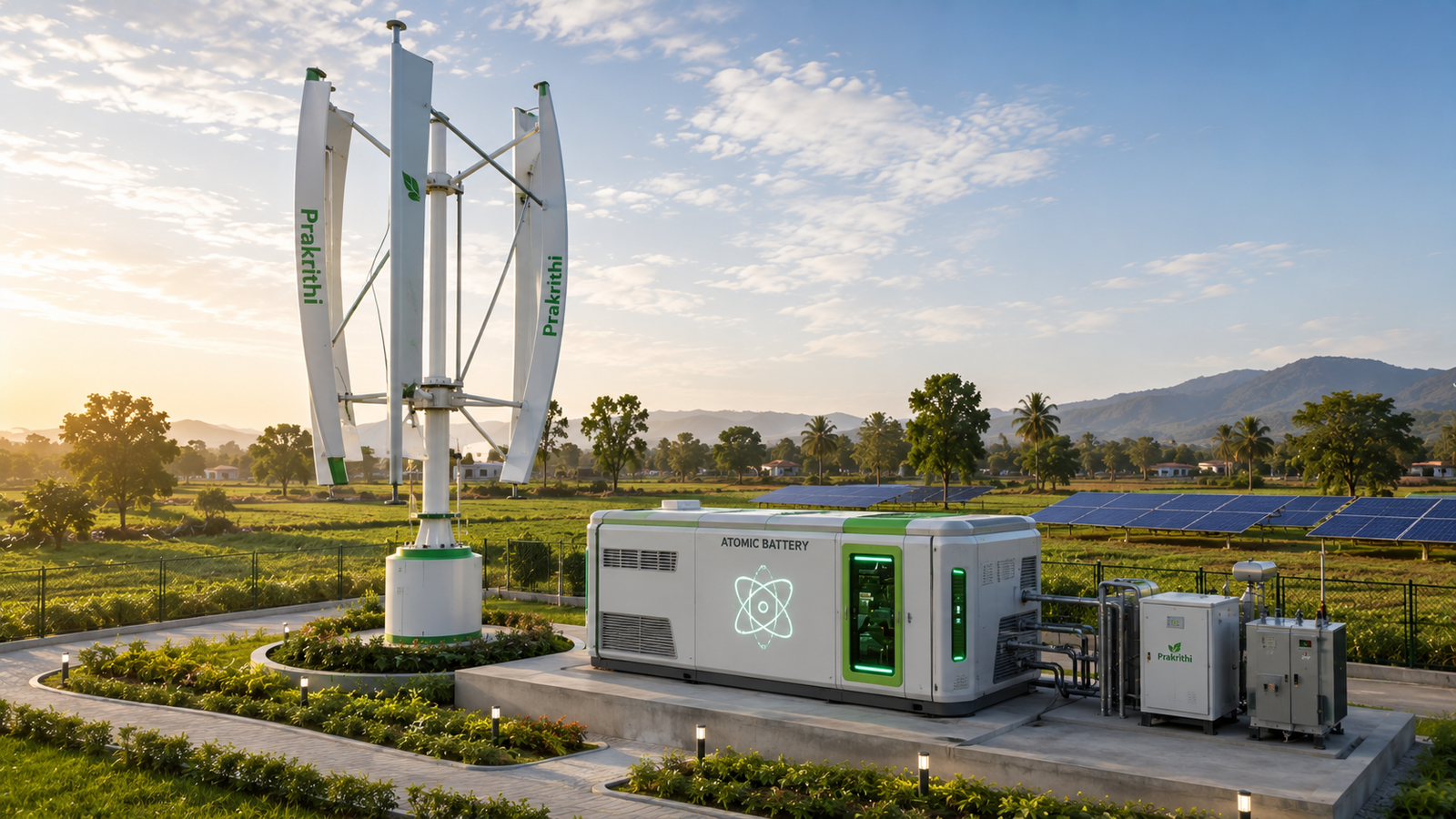
The Prakrithi concept features a vertical-axis turbine designed for a compact installation environment. Its proposed 1 kW electrical output represents a small-scale renewable energy system suitable for exploring distributed power generation.
How a Vertical-Axis Wind Turbine Works
Wind flows around the turbine blades.
The aerodynamic forces produce rotational motion.
The rotating shaft drives an electrical generator.
The generator converts mechanical energy into electricity.
Power electronics and energy storage, where provided, manage the electrical output.
Actual energy production depends on wind speed, turbine design, generator efficiency, operating conditions, and installation location.
C/N Pollutant Absorption: Exploring Cleaner Air
The second part of the Prakrithi concept focuses on air treatment.
Air pollution can include particulate matter, nitrogen oxides, and other pollutants. Different pollutants require different treatment technologies. A properly engineered system may combine filtration, adsorption, chemical treatment, or other air-cleaning processes according to the target pollutants.
Carbon- and Nitrogen-Containing Pollutants
Carbon dioxide (CO₂): A greenhouse gas present in the atmosphere. Removing CO₂ from ambient air requires specialized carbon-capture technology, such as direct air capture. Conventional particulate filters do not remove CO₂.
Nitrogen oxides (NOₓ): Air pollutants generated by combustion and other industrial processes. Technologies such as catalytic treatment and specialized adsorption systems may be used for NOₓ removal, depending on the gas composition and operating conditions.
Particulate matter (PM): Small airborne particles that can be removed from an air stream using suitable filtration systems, including high-efficiency filters and other particle-control technologies.
The Prakrithi concept brings these environmental concerns into one technology vision, while the actual pollutant-removal performance would depend on the selected equipment, airflow, energy consumption, and verified testing.
Integrating Renewable Energy and Environmental Engineering
Combining a wind turbine with an air-treatment unit creates an opportunity to study how renewable electricity can support environmental technologies.
A possible system architecture includes:
Vertical-axis wind turbine for electricity generation.
Generator and power-management equipment.
Air intake and treatment chamber.
Appropriate filtration or pollutant-removal modules.
Monitoring sensors for air quality and system performance.
Optional battery storage or grid connection.
The turbine's electrical output would need to be matched with the energy requirements of the air-treatment system. A 1 kW turbine does not automatically provide sufficient power for continuous industrial-scale air purification or carbon capture.
Potential Applications
Rural and Agricultural Areas
Small-scale renewable energy systems can support selected electrical loads in rural locations, subject to available wind resources and installation conditions.
Industrial and Commercial Sites
Air-treatment systems may be designed for specific industrial exhaust streams or controlled indoor environments. Pollutant removal depends on the application and the selected technology.
Environmental Research
The combined platform could provide a foundation for studying wind energy, air-quality monitoring, filtration systems, and energy-efficient environmental engineering.
Sustainable Infrastructure
Distributed clean-energy systems can contribute to sustainability initiatives when designed according to local energy needs, environmental conditions, and engineering requirements.
Engineering and Research Opportunities
Prakrithi's environmental technology concept connects several engineering fields:
Renewable Energy Engineering: Turbine aerodynamics, generator design, power conversion, and energy storage.
Mechanical Engineering: Structural design, rotating machinery, airflow systems, and equipment integration.
Electrical Engineering: Power electronics, electrical distribution, monitoring, and control systems.
Chemical and Environmental Engineering: Adsorption, catalytic treatment, filtration, pollutant measurement, and process design.
Data and Automation: Sensor integration, system monitoring, performance analysis, and intelligent control.
These disciplines can work together to explore sustainable technologies for future applications.
Measuring Real Environmental Performance
A clean-energy and air-treatment system should be evaluated using measurable engineering parameters.
Important performance indicators include:
Electrical energy generated in kWh.
Turbine rated power and operating conditions.
Airflow rate through the treatment system.
Pollutant concentration before and after treatment.
Removal efficiency for each target pollutant.
Energy consumed per unit of air treated.
Filter or adsorbent service life.
Maintenance and operating requirements.
For CO₂ capture, additional measurements such as captured mass, energy consumption per tonne of CO₂, and regeneration requirements are important.
These measurements help distinguish a technology concept from a validated environmental solution.
Prakrithi – Clean Air. Clean Energy. Sustainable Tomorrow.
Prakrithi explores the possibilities of renewable energy and environmental innovation through engineering-led concepts.
The vertical-axis wind turbine and air-treatment system represent a vision of integrating clean electricity with technologies designed to address environmental challenges.
Through research, design, testing, and responsible engineering, Prakrithi seeks to explore solutions that support a more sustainable future.
Prakrithi — Clean Air | Clean Energy | Sustainable Tomorrow.